Letter from the CEO
From the issue of our Value Statement, each of our decisions is ruled by these and all complex situations must be addressed taking into account this ethical awareness; with sustainable development of our operations and projects becoming one of our seven fundamental values as stated in the Charter.

I became Chief Executive Officer for the National Copper Corporation of Chile, Codelco, on May 19th 2010, appointed by its Board of Directors. In these months I’ve had the honor of leading Chile’s main company, a global leader in copper production, in a very positive and significant period, with deep transformations and advances in institutional and organizational areas as well as in the results of its management.
For Codelco, sustainability and social responsibility are an integral part of the Strategic Plan and corporate management. The company manages these areas based upon a model that incorporates safety, occupational health, environment, territory, community management – and also efficiency in the use of natural resources and the defense and development of markets.
On this occasion, I am glad to present the 2010 Codelco Sustainability Report, in which we account for our strategy and performance in the abovementioned matters.
With this report, we are acheiving 12 years of uninterrupted and transparent public information regarding our performance, and as in previous years, the report has been prepared following the guidelines set fofrth by the Global Reporting Initiative (GRI) Guide and the new supplement for the Mining and Metals Industry, 2010 version. This Report was externally verified by Ernst & Young, and has been rated as A+, the highest rating in terms of materiality, scope of contents and external verification, chacked for the first time this year by GRI.
When evaluating 2010, I conclude that it has been a year of unique and significative transformations for the Corporation. Regarding institutional matters, on March 1st the new Board of Directors was appounted in accordance with the new Corporate Governance Law, that follows the best practice of similar companies worldwide and to which all rights, obligations, responsibilities, and prohibitions of private owned companies are applicable.
Another priority relevant to Codelco’s 2010 management and its new Strategic Plan was the implementation of organizational changes, which sought a greater focus and efficiency in the management of operations and business activities; greater coordination and communication between the company areas, and an adequate structure to successfully face the challenges this future development demand.
Among the important changes we remark the creation of the Vicepresidency of Northern Operations, responsible for the Salvador Division and the new divisions Chuquicamata, Radomiro Tomic (formerly Codelco Norte Division), and Ministro Hales; and the Vice-presidency of Center and Southern Operations, which manages the El Teniente, Andina and Ventanas divisions.
The creation of the Vice-presidency of Administration and Finance, as the sole financial counterpart to the Corporation’s operations and projects, and the leveraging of the Vicepresidency of Human Resources, with an emphasis on achieving an agile relationship with trade unions, talent attraction and management, people recruitment and mobility, knowledge management, institutional renovation and the improvements in work practices.
The organizational changes required the designation of new top management executives and naming superior management. This process was carried out by means of focalized and selective searches for noted professionals in national and international mining, and on the other hand, by the promotion of our best professionals.
Udoubtedly, one of the most relevant achievements of this period was the preparation of the Codelco Value Satement and the revision of the Code of Conduct and Business Ethics, documents of the highest hierarchy within the Corporation. The final Value Statement document, presented in December, gathers the values and principles that must guide management at Codelco as well as guiding each and every one of its workers. For its preparation, Codelco carried out a highly participative process, where nearly 4 thousand workers participated either directly or by means of an interactive dialogue elaborated on our intranet during the month of October.
In turn, the Code of Conduct and Business Ethics, among other elements, is linked to the Complaints Line for alerting about anti-ethical actions which, since October 2010, was put at the public’s disposal through our webpage www.codelco.com.
Economically speaking this was a good year, as Codelco registered a US$5.799 million surplus, 47% higher than in the previous period, and mainly due to the strong increase in the international price of copper and molybdenum based on the maintenance of production levels. Copper production, both inhouse and subsidiary, reached 1 million 689 thousand fine metric tons (fmt), in line with the production reached in 2009. If we include Codelco’s participation in Minera el Abra, production increases to 1 million 760 thousand fmt. Codelco continues being the first world producer. Direct cash cost (C1) amounted 104.4 c/lb, greater than the 92.9 c/lb level registered for 2009. This increase in cost was influenced by greater compensations, product of incentives associated to the copper and molybdenum price; the continuation of the cost-push pressure of the prices of main supplies, and the fall of the exchange rate, which affected expenses incurred in national currency.
The earthquake affecting the central and southern part of the country on February 27 had no important consequences on costs or production for any of our operative divisions in the area, except for minor and completely recoverable production losses; which were mainly due to power outages and the rupture of a chute and spillage of tailings in the Andina Division, due to the rolling of a large rock. The stability of our massive installations, such as tailing reservoirs, slag heaps, and mineral waste deposits, as well as our surface and underground buildings; slurry pipelines, tailings ducts (among others), dealt successfully with one of nature’s toughest tests.
In terms of occupational safety, during 2010 Codelco achieved the lowest accident frequency rate in the history of the company, with a value of 2.02 accidents per million man-hours worked. However, we had to mourn the passing away of seven workers, three from our own resources and four from contractor companies, in four work related accidents. This result is proof of the need to redouble our efforts to eliminate events that result in worker injury or death from our operations, adopting a new standardized security system within Codelco which shall begin its implementation in 2011.
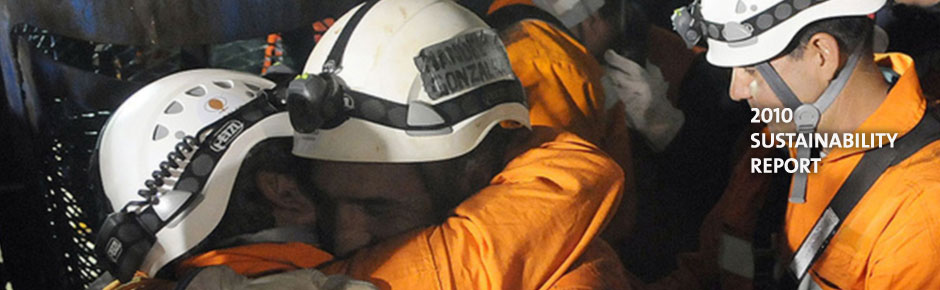
From the very beginning, Codelco was actively involved in the rescue of the 33 miners trapped in the San Jose mine near Copiapo. In total, over one hundred workers and professionals collaborated in an extremely complex effort which was lead by the Minister of Mining. It was a source of great pride for us to have headed the technical team which led this task and to have participated, along with other mining and services companies, in this great effort which has been forever engraved in the history of Chilean mining.
With regards to the work environment, to face the problem of an ageing organization and to move forward in a generational relay process, during this period the Severance Plans for divisions and corporate headquarters were implemented, in agreement with the respective trade union heads. By the end of 2010, around 2,200 people became part of this program, which considered knowledge retention in critical positions. Through this program, the average age was reduced to just over 45 years.
Regarding labor relations, agreements were reached free of conflict in collective bargaining with the trade unions of El Salvador (Rol A and Rol B), Radomiro Tomic (Rol B), Chuquicamata (Mining Trade Union Rol B), and El Teniente (Rol A) divisions.
Additionally, we launched a number of initiatives to promote productivity and quality of life, with special emphasis on educational, self-care, healthy eating habits, and physical activity programs. These programs have resulted in better absenteeism and overtime indicators.
Another important milestone of the period was the Board of Directors’ agreement that reverted the decision to close the El Salvador Division (initially scheduled for December 2011), given the improved perspectives of the copper market; the begining of actions to plan its operations in a mid-term perspective, and identify development opportunities in the long term. In parallel, the pre-investment study for the San Antonio Project was accelerated in this Division.
During 2010, investments in work and occupational safety reached US$ 145.6 million; and in environmental projects, US$61.6 million.
Furthermore, we can highlight other advances in sustainability:
- Within the framework of the Global Program for Eradicating Silicosis in the World by the Year 2030, Codelco hosted the Moving Toward Silicosisfree Mining seminar, to present the Global Program, review the current situation of Codelco operations, and consolidate a coordinative instance to approach the subject.
- Reduction of the general inventory of wastewaters by the Corporation: from 25 effluents in December 2009 to only 15 in 2010. We highlight the fruits of our efforts to eliminate our wastewaters, managing to officially close 10 of our discharge points in 2010, along with improving our water usage efficiency, increasing the recirculation percentage by 1% regarding the previous year.
- Four important projects were approved by the EES: Rajo Sur, of the El Teniente Division; modifications to the Ministro Hales Mine Project; Underground Chuquicamata and Transport of Anode Slimes.
- Compliance with the requirements established by the European Union to allow the entry of chemical substances to that region (REACH) and the new system for the classification and labeling hazardous substances.
- Development of over 400 social projects, in alliance with public and private institutions, amounting over US$ 6 million.
- Development and update of the corporate guidelines for mine closure.
- Revision and update of the Corporate Master Plan for Water Resources and the generation of a specific program on water related instrumentation in each Division.
- Begin Phase II of the Closure plan for El Minero waste deposit (El Teniente Division), which contemplates the retrieval, transfer, and disposal of stable arsenic residues.
- Approval of action plans for the implementation of a Corporate Glacier Strategy.
- Update of the life cycle inventory for the main commercial copper products.
- Continuing the implementation of the Energy Efficiency Plan.
Codelco has continued to have a leading role in terms of market promotion and development, heavily supporting the marketing branch of the industry, the International Copper Association (ICA).
An important milestone during 2010 was the creation and copyright of the Antimicrobial Copper Cu+ brand, developed by the ICA, highlighting copper’s antimicrobial properties and launching its global deployment. Codelco’s Corporate Headquarters is the first building in Chile that included Cu+ copper in contact surfaces of its public areas.
In addition, Codelco, by means of the INCuba subsidiary, consolidated the undertaking for new uses of copper in the acquaculture sector, with relevant technological and commercial development that includes 60 copper mesh cage systems for salmon production and with growth expectations in Chile and the world.
In terms of transparency and amounts of our acquisitions, during 2010 Codelco signed contracts with 2,237 suppliers, 1,289 service providers and 357 suppliers who delivered goods as well as services. The total amount assigned reached the sum of US$ 18,157 million. This amount, far in excess of previous years, is explained by the signing of long term contracts for the supply of electric power (US$ 12,303 million) and contracts for fuel supply (US$ 1,807 million). 87% of our contracts were awarded in public or private tender processes.
Finally, when analyzing Codelco’s main challenges for the next ten years, we must be clear that due to the age of our operations, which date further back than 100 years, we have mature deposits and decreasing laws. This increases production costs, given the longer transport paths, lower mineral availability, greater amount of waste and greater energy and water consumption. Although this is a problem faced by the entire mining industry, not only in Chile but in the entire world, these factors affect costs, competitiveness and Codelco’s sustainability efficiency indicators.
The way to face this great challenge for the Corporation is with structural projects executed according to the promised chronogram, budget, and with the assured quality, capacity, and results. This means the necessary conditions to secure Codelco in the long term and recapture the enormous potential of its deposits. The President of Chile has shown government support to executing the Corporation’s investment plan.
The execution of Structural Projects, in addition to investments in other projects with regards to the development, replacement and refurbishment of facilities, mine development, deferred expenses, environmental and safety projects, as well as other investments, has demanded a volume of resources without precedent in Codelco’s history. During 2010, for the fourth year in a row, the company made record investments: US$ 2,626 million.
Among the projects that entered into operation in 2010 stand out: Radomiro Tomic Sulfides Exploitation- Phase 1; Andina Development Plan – Phase I; Pilar Norte (El Teniente) and Gaby – Phase II, in addition to the approval of the Ministro Hales Project, which is one of four Codelco structural projects that have begun construction.
To partly finance the investment program and the payment of debts due that year, during 2010 Codelco turned to the capital market. In October we issued US$ 1 billion in international bonds, in 10 years term, at a rate that is the lowest obtained by any Latin American corporate issuer.
An important challenge is that despite the fact that all our divisions maintained their certification under ISO 14001 and OHSAS 18001 in 2010, we must improve control over our environmental incidents, especially those related to impacts neighboring our operations, given that in 2010 three relevant incidents occurred.
The most important challenge over the next few years is achieving a record of five years without fatal accidents, with a Frequency Index below 1 and automated hazardous processes.
Furthermore, we must keep and increase our social license to operate, by meeting or exceeding the environmental standards demanded and by participating in initiatives of greater scope in our development alongside the communities, and achieving the alignment of functional organizations so as to generate the best service for the divisions in terms of opportunity and quality, simplifying our management control tools.
To improve our performance and negotiate the new goals and challenges, I hope to count with the collaboration of each and every one of the workers and collaborators, with the same exemplary performance they showed when supporting the victims of the earthquake that ravaged the central and southern areas of the country in February 2010 and especially during the rescue of the 33 miners from the San José mine. To all of them, my deepest thanks for the labor accomplished. “What we do in the following three and four years will define the future of Codelco for the following decades. The challenge is to maintain the company’s leadership and that must be reflected in the actions of each area, of each of us, of each Division and each workplace. We must be leaders in everything, 365 days a year, 24 hours a day.”
