
Operations

Three municipalities join the recycling plan for used tires (NFU) with support from the El Teniente Division
The initiative is aimed at promoting environmental education and recycling in compliance with the Extended Producer Responsibility Law (REP), led by the Ministry of the Environment.


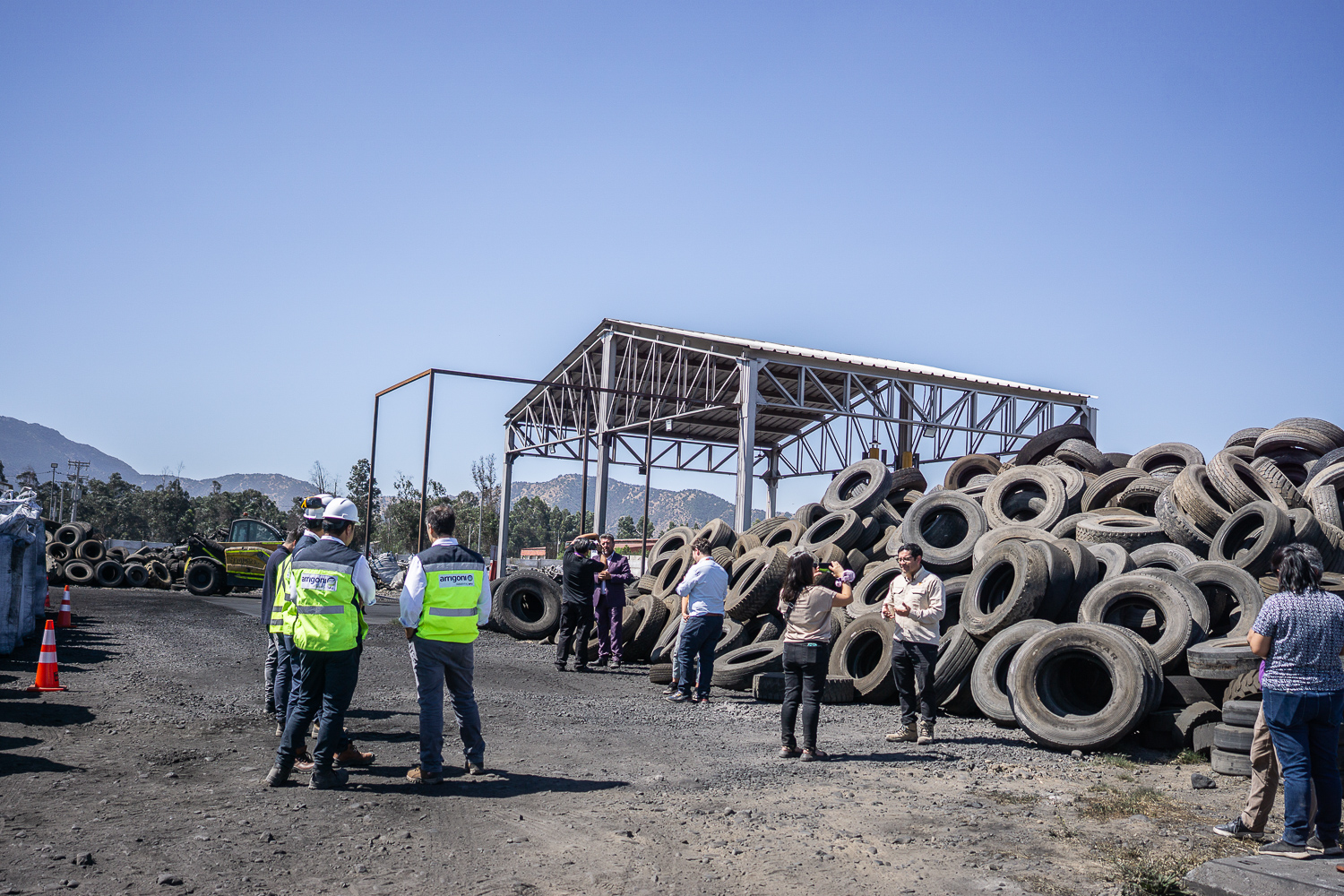
The campaign to collect and recycle tyres, promoted by the O'Higgins Regional Ministry of the Environment, the company Arrigoni Ambientals NFU and Codelco División El Teniente, has had a great reception in the communes of Coinco, Codegua and Graneros. The campaign seeks to reach 90 tonnes of used tyres that will be treated at the Arrigoni plant in San Francisco de Mostazal.
From the treatment of this waste, steel, AANFU Oil (an alternative fuel to diesel that can be used in boilers, furnaces and generators) and black coal are obtained, which can also be used as fuel.
“Our role in this campaign is to make this integration with the community and the environment, with the neighbors of our operations, evident through a contract we have for the collection of these tires, with 30 cubic meter containers that were installed in different points of the communes of Coinco, Codegua and Graneros,” explains Felipe Núñez, Head of Operations of the Circular Economy Unit of El Teniente.
The regional secretary for the Environment of O'Higgins, Giovanna Amaya, highlighted the interest that the initiative has generated in the communities and emphasized the collaboration that this initiative represents between the public and private sectors.
“This motivates us and fills us with pride that Codelco is joining these recycling campaigns, which are essential for environmental education. We hope to have around 90 to 100 tons of tires collected in these three communes, which were ultimately tires that ended up in the trash, in rivers or in unestablished places and that today will have another life,” Amaya postulates.
The recycling campaign lasted for the first three weeks of January, with different dates for each commune.
Alexis Flores, mayor of Codegua, says that “these alliances help us a lot, because these tires ended up in the streets, rivers, squares, piled up anywhere and can catch fire very quickly. Many tires from our neighbors arrived at the collection site, so we thank everyone involved.”
The recovery and recycling process
The general manager of Arrigoni Ambiental NFU, Gianfranco Arrigoni, explained that at the plant “we recycle tires through a process called pyrolysis, in which we put the tires into a reactor, heat is applied and a gas is generated that is then cooled and condensed to generate AANFU Oil. After 22 to 24 hours, the carbon black is removed through an internal system and then the steel. So we have these three by-products.”
In addition to the three communes in the O'Higgins region, Codelco División El Teniente was also responsible for transporting tires from the commune of Alhué, in the Metropolitan region. From there, more than 1,300 kilos of this waste were removed.
“This is a tremendous initiative on the part of Codelco. We know that tires and rubber take many years to disintegrate, so it is very valuable and noteworthy that more than a ton has been removed from our community and we want to thank Codelco for this type of public policy and we hope that it will be sustained over time,” said Roberto Torres, mayor of Alhué.
What does the REP Law state about tires?
The Extended Producer Responsibility Law (REP) of the Ministry of the Environment, specifically regarding the recovery of used tires, came into effect on January 20, 2023 and requires manufacturers and importers of six priority products to recover a percentage of them once they reach the end of their useful life. From this date, all producers – including all importers of tires, both replacement and new cars – must adhere to a management system to comply with the goals and associated obligations.
The main obligations include the collection and valuation of tires, both nationally and regionally, and the delivery of information regarding the status of adherence to a management system in the import declaration before the National Customs System.
×