
Operations

El Teniente workers develop project that creates concrete from tailings sand
The idea - winner of an innovation contest by the Codelco Division - replaces the use of river sand in the production of concrete and allows for the consolidation of a circular economy initiative and contribution to the environment.


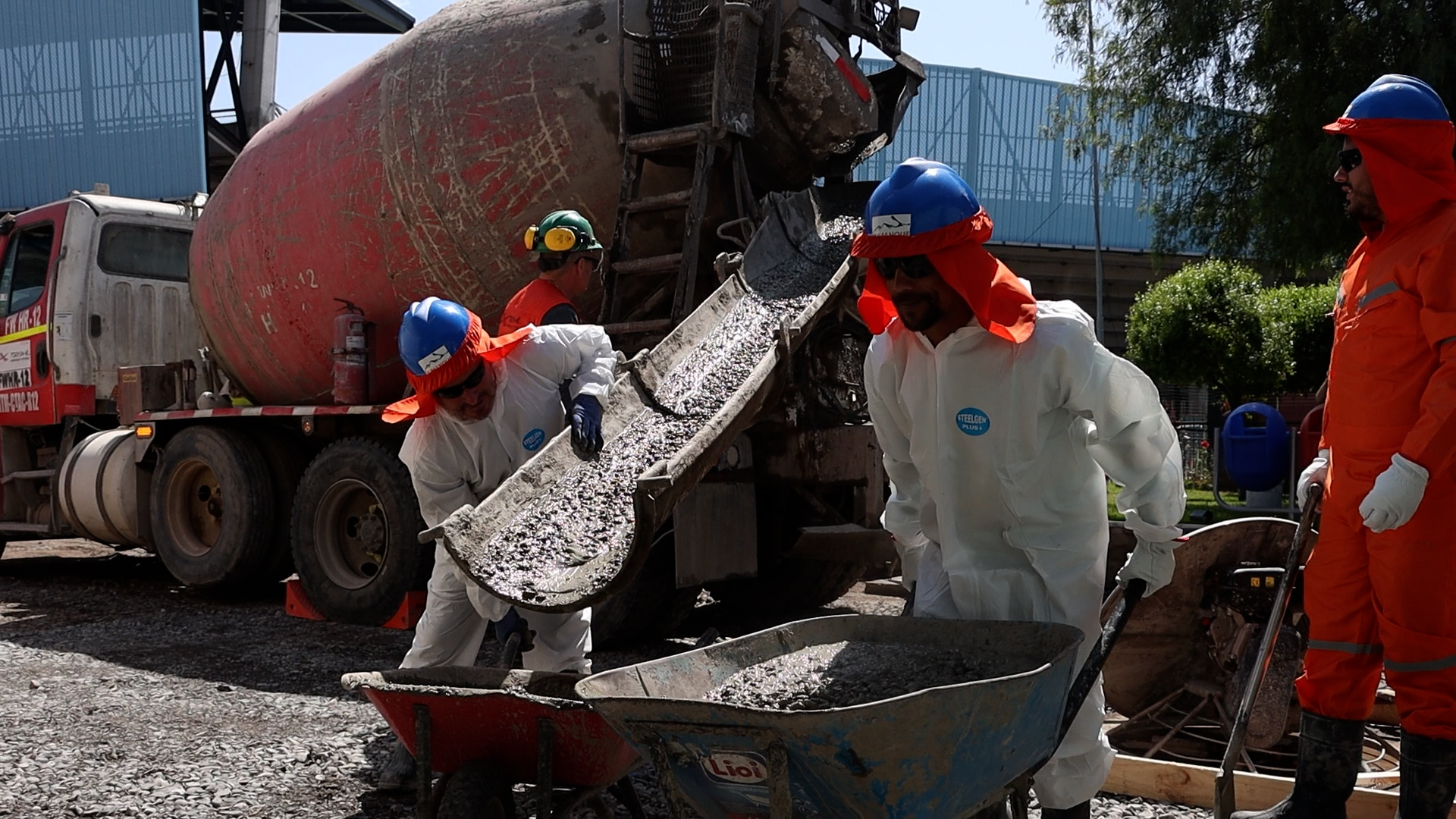
In November 2019, Luis Vergara and his partner Miguel Díaz, proposed one of the almost 500 ideas that workers submitted to the innovation contest Create The aim was to demonstrate the feasibility of using sand from mine tailings to make concrete. And they succeeded. Four years later, the innovation has already been tested as shotcrete (material for reinforcing tunnels) inside the underground mine and, recently, as concrete for the construction of a 140-square-metre slab in the El Teniente stadium.
“The project for concrete with tailings sand consists of using this mining waste as a supplementary material for the manufacture of concrete and/or shotcrete, maintaining the quality of the current product. Laboratory tests determined that with the use of 2.5% of sand from the Barahona dam, the material did not lose its mechanical strength, which allows for a new use of this environmental liability. Now we aspire to replace the sand by 5% and then reach 10% or more,” explained Luis Vergara, head of operations for the Concrete area of the Energy Superintendency.
The idea evolved from paper to effective use in the manufacture of concrete with the support of the Innovation Department of El Teniente and the technical knowledge of the specialists from the IDIEM laboratory (Research, Development and Innovation of Structures and Materials) of the University of Chile.
Tailings are waste products of ground rock, minerals, water and heavy metals, among other components, which are left over from copper processing. The project has sought to give this waste a new use as supplementary material for the manufacture of the 14,500 cubic meters of concrete and/or shotcrete used monthly at El Teniente.
“Thanks to this initiative, a contribution is also made to river conservation by minimizing the removal of sand and aggregates from the riverbeds and benefits such as lower operating costs and environmental contribution,” said Luis Vergara.
Circular economy
After being applied as shotcrete in the Pilar Norte sector of the El Teniente mine, it was decided to use it on an esplanade of the El Teniente Stadium. “It is a material that set well and it is noticeable in this slab of 20 by 7 meters and with a depth of 15 centimeters. The process was fast. The concrete was applied in one day and the setting took another two. It is a great opportunity to update a liability. River sand is increasingly scarce and using the sand found in our tailings, such as Barahona, is virtuous because it generates a circular economy,” said Adolfo Lara Pozo, head of the Logistics Operations unit of the Services and Supplies Management of the mining company.
Luis Salas, site manager for Pumanque, the company responsible for building the slab at El Teniente stadium, explained that “we compacted the area, prepared a court and applied 17 cubic meters of concrete prepared with tailings sand, gravel and cement. It set very well.”
The use of tailings sand could provide a sustainable use for 50 million cubic meters of material found in the Barahona sector, in addition to reducing the costs of moving aggregates by 5%, also contributing to the reduction of the carbon footprint, due to less equipment mobilization.
“We are delving deeper into innovation to apply new technologies and specific goals for waste and tailings. This initiative allows us to demonstrate the contribution we make in terms of the circular economy, which is one of the 5 axes that Codelco has set out to advance in terms of sustainability by 2030,” said Victor Dörner, Innovation and Development consultant at El Teniente.
×