
Operations

El Teniente's circular economy project will recycle more than 50 tons of copper cables per year
The process seeks to reduce the amount of waste generated by the Division and thus contribute to the valorization of electrical conductors discarded from the operation.


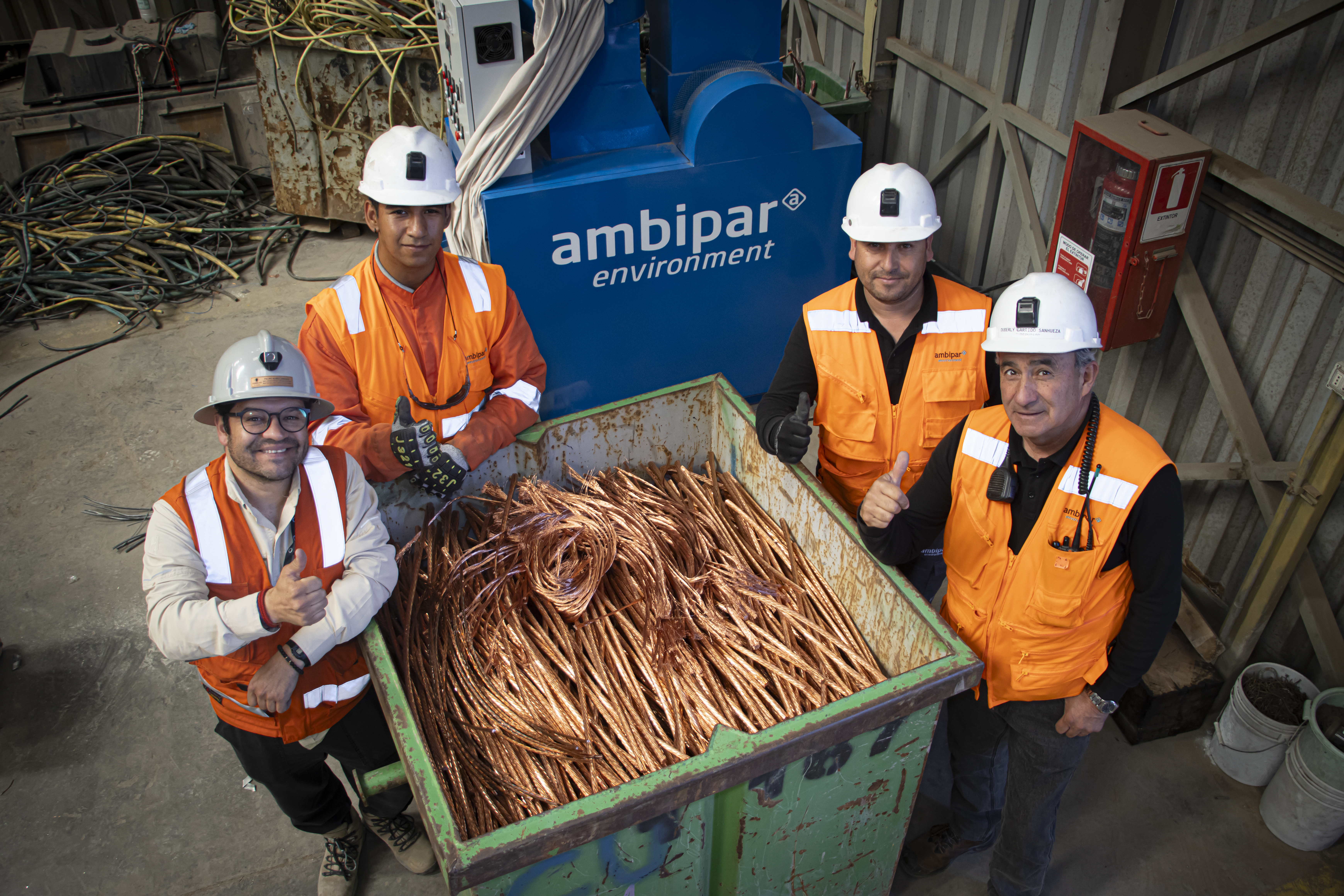
In the El Teniente Division, a new circular economy project was launched, aimed at recovering 50 tons of copper cables annually that are currently discarded as waste.
Previously, waste electrical conductors of different sizes arrived at the Industrial Waste Management Center (CMRIS), where they were accumulated and sold as cable scraps, without being processed or separated. Currently, the different raw materials that these conductors contain are being recovered, such as the copper core, plastics, some non-ferrous metals and other insulating elements that make up the cable.
The idea arose from the concern and collaborative work of the team of workers in the area, made up of personnel from Codelco and Ambipar Environment, who considered that recycling these cables could create a contribution to the Division, both in environmental and economic value.
This resource optimization process seeks to recover 50 tons of cable scrap, the revaluation of which is estimated at 350 million pesos per year, reducing the environmental impact and contributing to the economic value of the Division.
Revalue copper and other raw materials
Ernesto Ly, Large Contracts Manager at Ambipar Environment, an environmental management company in charge of CMRIS administration, says that “our experience of more than 40 years serving the mining industry allows us to identify opportunities to take advantage of waste, such as, in this case, unused cables to extract copper and reinsert it into the production process, in addition to virgin polypropylene fibers, steel, and scrap metal.”
The head of Circular Economy Operations, Felipe Nuñez, says that this initiative will allow “us to transform waste into raw material again. We are gaining copper recovery and we do it on site. Approximately 50 tons of electrical conductor waste of different sizes and specifications are generated each year, and what we are doing is valorizing them into copper and other raw materials such as plastics, HDPE (high-density polyethylene), aluminum, among others.”
Duberly Garrido, CMRIS Project Supervisor for the El Teniente Division, said that “it took us a long time to gather the necessary quantity to generate bidding processes of interest to the market. We were losing many kilos of cable and now we will take advantage of the raw material.”
The copper rescue process
In the El Teniente Division, various types of cables are used that must be separated. The machinery and processes implemented by Ambipar allow household power cables to be introduced into an automatic cable processor, which cuts them up and produces “copper rice.”
Larger industrial cables, on the other hand, are fed into a manual machine, which opens the cable and allows access to the various coating by-products, such as plastic, rubber and aluminium. The copper obtained is sent to the foundry as raw material.
Guillermo Rey, CMRIS Circular Economy supervisor at Ambipar Environment Chile, highlights the importance of valorising this waste: “We want even the cable that cannot be sorted to have a final destination that can be valorised and that there is no waste. We gradually learned about the process and, working sporadically, we obtained 1.2 tonnes of copper in one month from the offcuts.”
CMRIS yard assistant Gerson Gómez explains that “there are industrial cables that even have leather, aluminum, and rubber coatings; so it is very innovative, because this has never been done before and copper is the main product for Codelco.”
×