
Press

Codelco launches circular economy roadmap with the goal of recovering 70% of its non-hazardous waste by 2030
With projects ranging from retreading heavy-duty tires to reusing rubble and recovering metal supplies, the state-owned company is moving towards an operation that transforms its own waste into resources, generating savings of millions of dollars and reducing its environmental footprint.


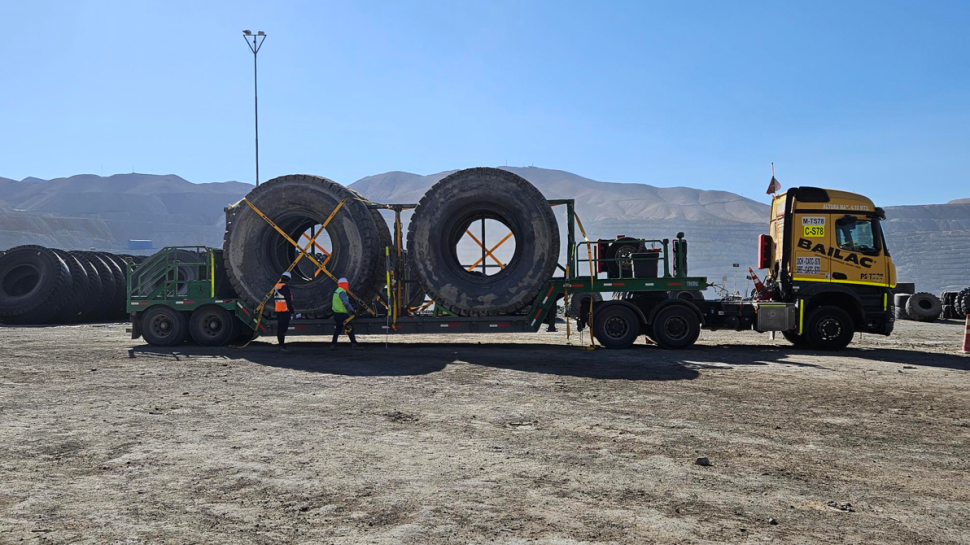
Santiago, April 16, 2026 – “We are building the future with sustainability.” This phrase, part of Codelco’s Values Charter, sets the course for a more responsible operation with respect to the environment and communities. In this context, the Corporation consolidated its circular economy roadmap, a comprehensive strategy with an ambitious goal: to recover value from 70% of its non-hazardous waste by 2030.
This plan responds to international and national commitments such as The Copper Mark responsible production seal, the principles of the International Council on Mining and Metals (ICMM), the Extended Producer Responsibility (EPR) Law, and the National Mining Policy 2050. Furthermore, it is structured around three fundamental pillars: the implementation of operational initiatives in the field, with a broad portfolio of projects; the development of internal corporate guidelines that ensure traceability and standardization in contracts; and the creation of innovation ecosystems with suppliers and local stakeholders to increase the possibilities for adding value.
“At Codelco, we understand that today there is no sustainable production without environmental responsibility. The circular economy requires us to review every process and every input, and this not only reduces impacts but also improves our efficiency and competitiveness. The results on the ground confirm that it is the right decision, both environmentally and economically,” explains Gabriel Méndez, Vice President of Corporate Affairs and Sustainability at Codelco.
Tires, rubble and metal waste
The roadmap defines 18 concrete initiatives to achieve the 2026 recovery targets. This number increases to 54 in the 2030 plan. The actions focus primarily on the management of the main non-hazardous waste generated by the Corporation, such as end-of-life tires (ELTs), debris from different stages of operations, and metals from scrap and worn-out supplies.
One of the most significant circular economy projects in the area of end-of-life tires is the preventive retreading of haul truck tires (CAEX), which can reach a diameter of over 4.5 meters. Recent experience at the Chuquicamata Division demonstrated the potential of this system. Between January 2024 and June 2025, 321 of these tires were retreaded in partnership with an external supplier. Extending the lifespan of this key component for mining vehicles reduced waste by 1,293 tons and avoided the purchase of 121 new tires. This resulted in savings of approximately US$2.2 million for the Corporation.
In parallel, Codelco is promoting an innovative system that allows the use of construction debris as a replacement for natural aggregates, resulting in a direct reduction in costs. By 2026, for example, the company projects managing 12,600 m³ of construction debris generated at the Radomiro Tomic Division, which will be converted into recycled aggregates through an internal process for the construction of infrastructure at the Talabre tailings dam. This represents a total savings of US$3.77 million, as it eliminates the need to purchase new material and avoids the transportation of the debris to its final disposal site, in accordance with current regulations.
The roadmap also includes scaling up circular input models, with a special emphasis on initiatives that have already demonstrated successful results in different divisions. Among these, the grinding ball recovery model, currently implemented at El Teniente and Andina, stands out. This model will be extended to Salvador in 2026. It involves the supplier collecting worn-out grinding balls and scrap metal, repurposing them as raw materials to manufacture new balls.
During 2025, circular input models, which include the recovery of grinding balls among other initiatives, generated direct benefits exceeding US$700,000. By 2026, the projection is to double these results and recover more than 5,000 tons of waste, which will be reincorporated into the operation through circularity.
“One of the most important lessons learned from this process is that the circular economy works best when it involves suppliers from the beginning. The grinding ball recovery model is a perfect example: the supplier removes the waste, revalues it, and returns it as an input. Everyone wins, and the cycle is closed. That's what we want to replicate,” says Pablo Contreras, Climate Action Manager at Codelco.
Codelco


×