
Operations

Secondary Crushing Plant starts pilot plan for the use of exoskeletons
This initiative, shared with the ergonomics team and the Occupational Accident and Occupational Disease Insurance (SATEP) of the Occupational Health and Safety Department, contemplates the use of a harness that protects the worker's posture and takes advantage of all the muscles of the body, avoiding injuries.


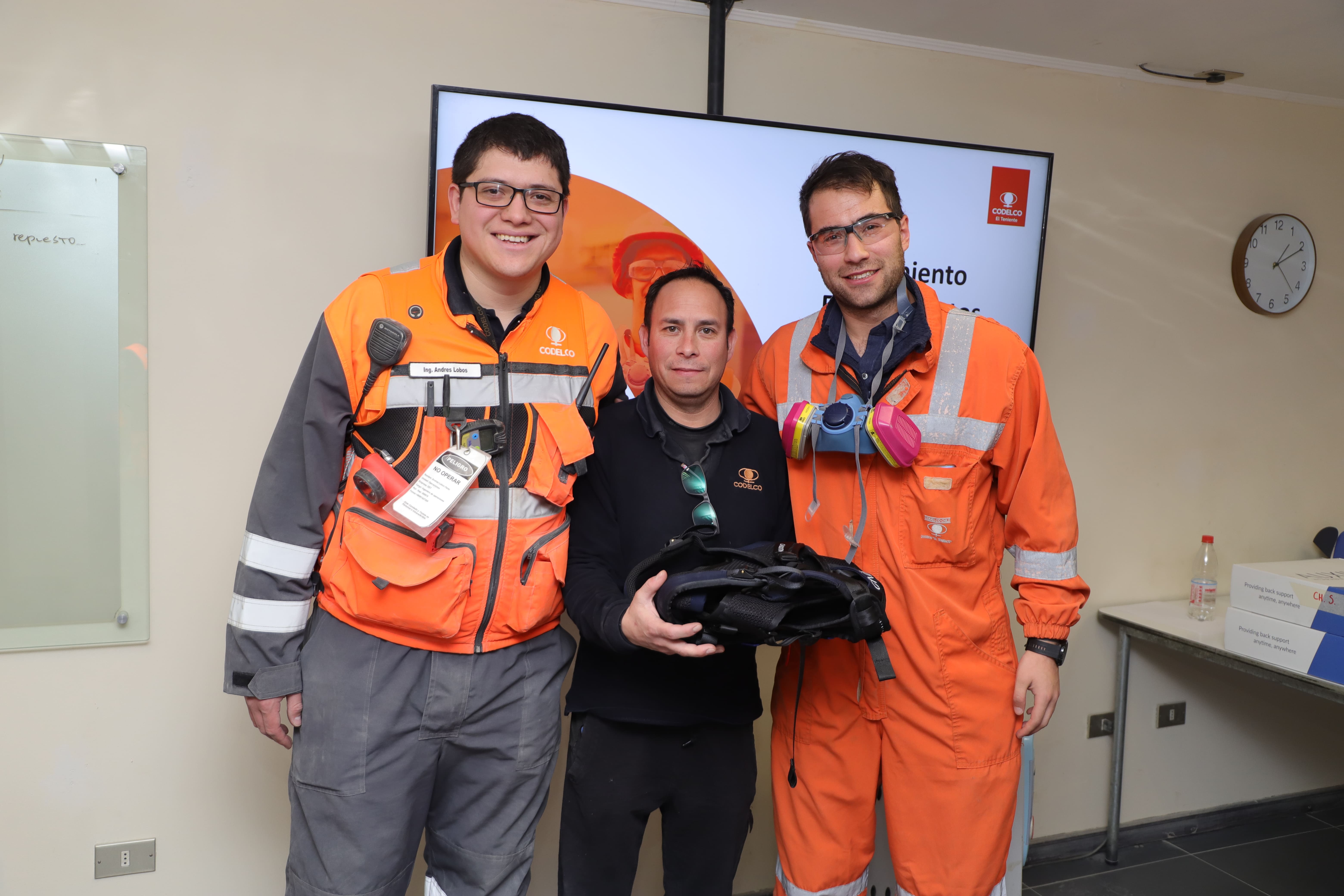
With the aim of improving ergonomics and the quality of work of the workers in the area, the pilot plan for the implementation of the use of exoskeletons in the Secondary Crushing Plant of Codelco El Teniente Division was launched.
An exoskeleton is a type of equipment that assists or increases the capabilities of the human body and is currently being used in some types of jobs where people are exposed to physical effort. The device that will be implemented in the Division will be a “LiftSuit”, of Swiss origin, and with a structure similar to that of a harness.
Vicente Sepúlveda, co-founder of Andes Levers, the company that imports them, says that “the LiftSuit weighs around 900 grams and is designed to help the dorsal-lumbar area. It limits bad posture and distributes weight thanks to the artificial muscles , which are a type of elastic that the model contains,” he said.
Andrés Lobos, process engineer at the Secondary Crusher, explained that with the implementation of these exoskeletons “we were able to start a project to focus on the person and the work that our operators do. It is a pilot project that will last three months and the idea is to extend it to other plants in the management.”
For the traumatologist and director of the Insurance for Workplace Accidents and Professional Illnesses (SATEP) of El Teniente, Eduardo Ahumada, the initiative is remarkable because “it takes advantage of all the muscles in the body. When you normally exercise or move, you don’t take advantage of all the potential. So this uses that energy that is not used, which reduces the load on the muscle and prevents wear and tear or illness.”
Mechanical maintenance technician Oscar Moya says: “I have been working in this area for 15 years and I think it is a good initiative because it helps us when we do jobs that are repetitive and require us to use a lot of force when moving.”
“The idea is to improve posture and the quality of work. It is an issue that is relevant for the new generations and also for the older ones who must also learn to improve their postures,” adds Francisco Contreras, an expert operator.
Michelle Castillo Sanhueza, an ergonomist at the Occupational Health Department, explains that “it is a good initiative to introduce and implement new technologies. In addition, it promotes gender inclusion because the equipment to be implemented is unisex and can be used by men and women alike.”
×