
Operations

Successful release of a rehabilitated bird of prey at Hacienda Cauquenes in the El Teniente Division
The nuco, a rare species in the O'Higgins region, was in recovery for 25 days at the Hacienda Cauquenes Rehabilitation Center in El Teniente, thanks to an alliance between Codelco, the University of O'Higgins and the Agricultural and Livestock Service (SAG).


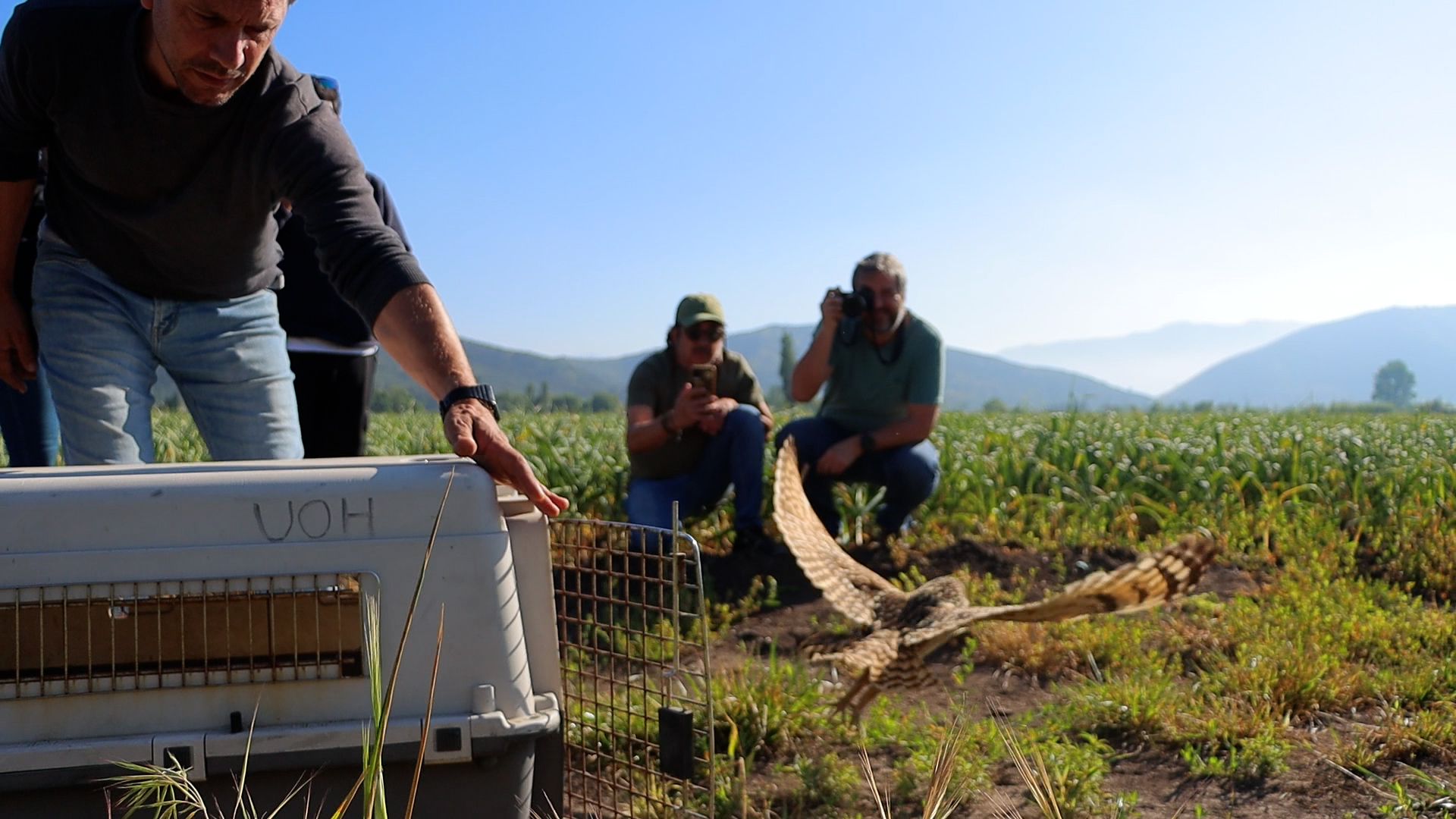
Representatives from Codelco's El Teniente Division, the University of O'Higgins and the Agricultural and Livestock Service (SAG) participated in the release of a nuco, a bird of prey similar to an owl, which was rescued and rehabilitated after being found with various injuries. The bird spent 25 days at the Rehabilitation Center at Codelco's Hacienda Cauquenes, to recover its natural hunting and flying abilities.
This milestone is part of the collaboration agreement between Codelco El Teniente Division and the University of O'Higgins, which includes a specific agreement on biodiversity, through which technical assistance services and care for animals, flora and native fauna of the region are provided. In partnership with the SAG, this space allows for rescue protocols after sightings of injured birds.
Germán Sandoval, Sustainability and External Affairs Manager at El Teniente, said that “this milestone materializes the work we have been doing with the Universidad O'Higgins for several years, through this agreement that includes the care of biodiversity. At El Teniente we are committed to the preservation of fauna in the region and, through collaborations like this, we seek to achieve triple value, where the environmental component is fundamental.”
María Alejandra Cuevas, director of Transfer and Innovation at the University of O'Higgins, added that “the importance of the agreement is that, through the knowledge of the university, we assist species that need attention, such as this nuco. In addition, we carry out research, which is another very important aspect. In the case of technical assistance, these are basically activities that link us to the region and allow us to contribute to biodiversity.”
Diego Ramírez, regional coordinator of Wildlife at SAG O'Higgins, explained that “the nuco, or asio flammeus, is a very rare species in the region, because they are 'habitat specialists' that require a specific environment, with certain humidity conditions. In O'Higgins, these suitable habitats are becoming less and less abundant. That is why, together, we have made all these efforts to rehabilitate and release it in good conditions in a suitable place.”
Rescue and release
The bird was found in poor condition on September 4 on the outskirts of Rengo by representatives of the Agricultural and Livestock Service (SAG) and the NGO Tejiendo Ecologías, who immediately committed to its rescue and recovery. At that time, the bird was unable to fly and had a damaged wing, which required urgent attention.
Andrés Saldaña, a photographer and member of the Rengo community, was instrumental in rescuing the animal. "A friend's mother told me that she had found a nuco on the street. This species is difficult to find, seeing a nuco in an urban area is something unique. The collaboration between different professionals was essential for the nuco to return to its home," he said.
From there, he was transferred by the SAG to a specialized clinic, where they diagnosed a soft tissue contusion in the scapular region. That same night, he was transferred to the Rehabilitation Center of the Hacienda Cauquenes of Codelco Division El Teniente.
The specimen remained in a small cage for 25 days, where it received constant food and care, until it was moved to a larger space, to regain muscle and mobility, with live prey that allowed it to hunt again. Finally, it was determined that it was in optimal condition for release.
Eric San Martín, acting director of Environment at El Teniente, said that “as a Division, we are proud to participate in this release, which contributes to the rehabilitation and return of rare species in our region. Biodiversity is a fundamental part of Codelco’s Sustainability Master Plan, and for this reason, we are always willing to preserve our native fauna.”
Tags
×