
Operations

The Teniente recovers production in sectors affected by the largest seismic event that occurred in the Division in 2023
Adaptation and teamwork have gradually allowed us to resume operations and restart the incorporation of exploitation areas, which now reach 3,000 square meters.


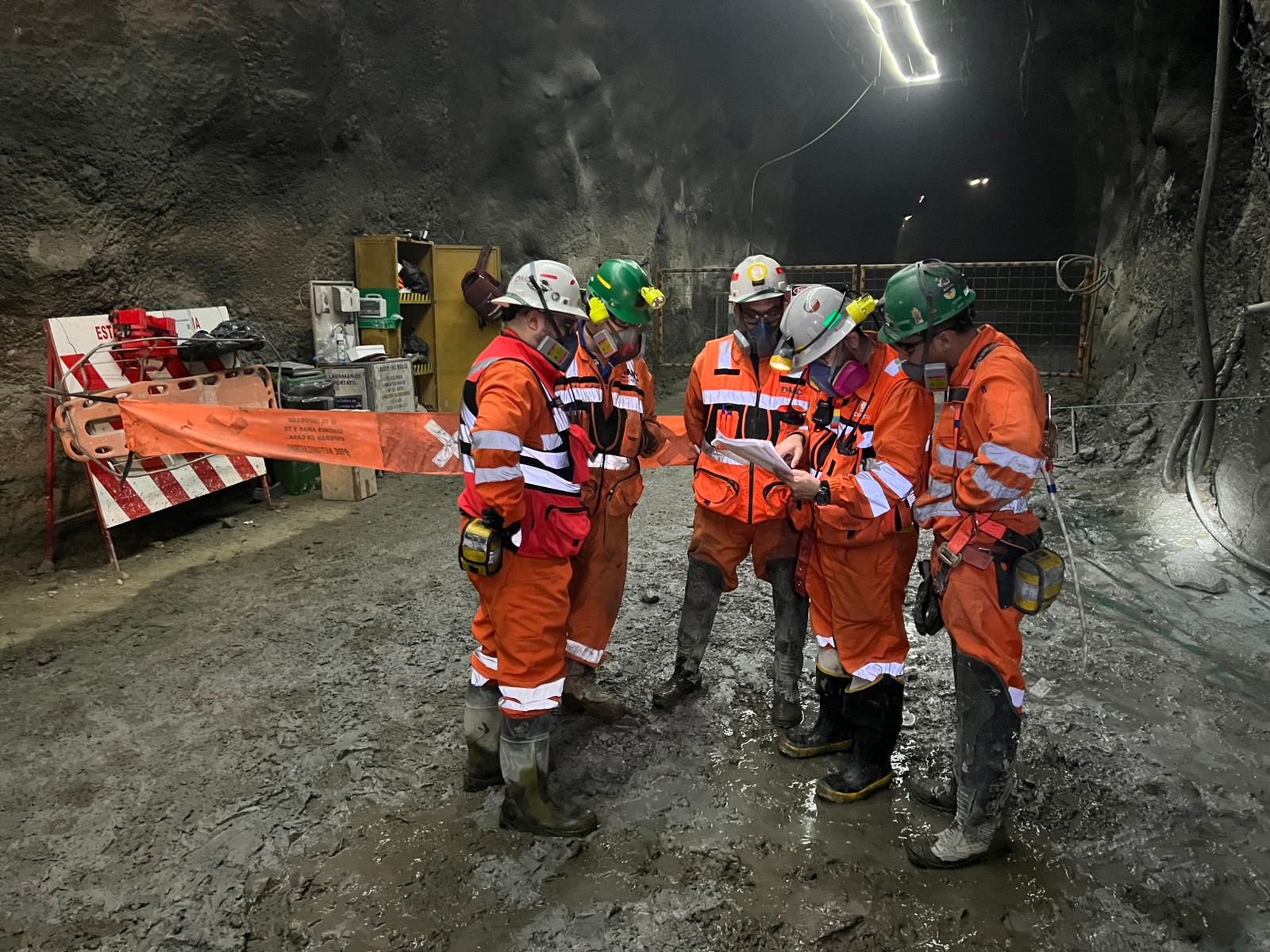
July 24, 2023 was etched in memory for many El Teniente Division workers. Especially for those who were inside the mine. That day, in the early morning, the largest seismic event in the history of the mining company in the O'Higgins region occurred.
“The Pilar Norte sector, Unit Sub-6 and Teniente 7 were affected. More than 2 thousand linear meters of galleries fell, which completely stopped the exploitable areas of Recursos Norte and Reservas Norte and left only Dacita in operation,” explains Nolberto Vega, head of Unit Sub-6 of Codelco División El Teniente.
Production, which before the earthquake was around 50,000 tons per day, suddenly dropped. “We dropped by half, to around 24,000 tons per day,” says Vega.
It was necessary to act quickly. Resuming the operation was the ultimate goal for which teams from different units worked together and with safety as a permanent discipline. The operation was gradually resumed and a year and two days later, the growth front was reactivated.
“We restarted growth on July 26, 2024, with the blasting in Ditch 41, 22-23 Street, at exactly 04:03,” Vega recalls proudly.
Adaptation and teamwork
Damage assessments, definition of roles, responsibilities and zoning were the prelude to repairs.
“We tried to understand what had happened to us and the consequences that this had not only for those areas, but for the entire mine,” explains Victor Coros, Planning Engineer of the Mining Resources and Development Management. “All this to activate production as quickly as possible and the impacts it had on the incorporation of the area, through a repair strategy and establishing priorities, which was one of the most complex points.”
Challenging limits, adapting and capturing learnings were key to the stages that came next.
“This forced us to modify the strategy. With the team we were incorporating areas, working on drilling and blasting, but we had to transform and get into repairs,” explains Francisco Llanca, head of the Drilling and Blasting Shift of Sub-6. “It was a challenge for everyone, teaching and learning what repair work is like, being alert because there are other risks.”
Patricio Flores, head of the Preconditioning and Repairs Unit of the Superintendency of Mining Services, led part of these tasks. “The biggest challenge was being able to reinvent ourselves to achieve this final objective. There were jobs that forced us to look at things differently, to think differently in order to solve problems. And on the other hand, we always kept safety in mind. We have not had any injured workers and, so far, we have completed more than 80% of the repairs,” he says.
Regarding the incorporation of fresh reserves for exploitation, the focus today is on adding 10,500 square meters, of which almost a third has already been completed.
“We have added around 3,000 square meters between July and August, and we are on track with our program,” says Diego Garcés, Head of Growth at Mina Norte. So far, this addition of area has generated a production increase of 7,000 tons per day.
Coordination and security
One thing everyone agrees on is that unity was essential to successfully completing the repair work and resuming the growth of the mine.
“This demonstrated one of the pillars of our Seal of Leadership, which is the common goal. It was an instance where teamwork between the different areas was very marked and consolidated,” says Nolberto Vega.
Patricio Flores agrees: “For me, that was key. It also allowed us to strengthen security and I thank everyone who participated in this. With this we showed that we are capable of reinventing ourselves, acquiring knowledge, uniting visions and moving forward.”
Diego Garcés adds to the point. “Safety, planning and the involvement of everyone was very important, that there was that coordination. We also incorporated that as a learning experience to act in future emergencies,” he says.
Tags
×