
Operations

El Teniente Division optimizes railcar loading capacity with innovative non-stick film
The solution was tested on the Teniente 8 Railway, which transports ore from the inside of the mine to the surface, and prevents wet cargo from adhering to the walls of the cars, thus avoiding dead cargo, spacing out maintenance, with cost savings.


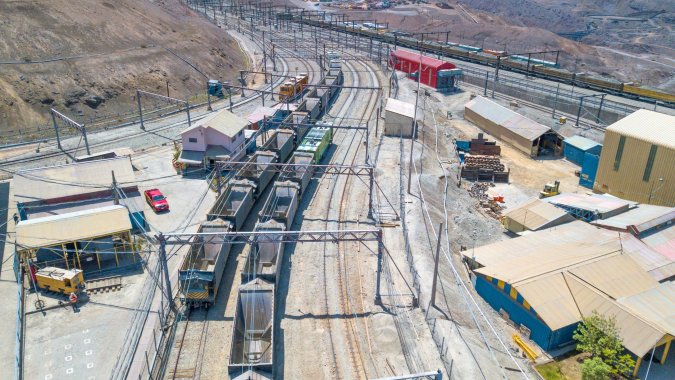
One of the growing challenges facing the Teniente 8 Railway Unit, in Codelco's El Teniente Division, is the transportation of wet ore, which sticks to the cars (receiving the name "llampo"), thus reducing the effective loading capacity.
After learning about some of the technologies used in the transportation of copper concentrate in mining operations in the north of the country and investigating possible solutions applied in the industry both nationally and internationally, with the support of the Innovation Directorate of the El Teniente Division, the unit sought to apply a coating to the cars that move the fine material in the Division.
“We spoke with a supplier company, they assessed our problems, reformulated a non-stick film and we did the tests that, so far, have been successful,” says Eduardo Villalobos, head of the Teniente 8 Railway Unit at Codelco El Teniente Division.
Thus, at the beginning of December last year, the non-stick film was applied to one of the transport carts, which, to date, has not shown any material attached to the internal walls.
“On average, 3 tons of material are attached to the carts per day. In this test cart, we have only reached 0.03,” Villalobos explains. These data are obtained thanks to an advanced system that shows the status of each cart in real time.
The improvement is substantial, considering that there are two trains with 20 cars each, with a load capacity of 100 tons, which make about 30 trips a day.
In this way, those three tons per car that were previously lost during transport, due to being stuck to the walls, can now continue their process in the concentration plant.
Operational continuity
Given the good results, the Unit will seek to scale up the project to apply this non-stick film to the rest of the cars.
“This will allow us more loading capacity by not having cars with flashlights, also considering that we are having more wet cargo and this will be a constant in the process throughout the year,” says Cristian Soto, shift manager at Unit Teniente 8.
In this way, the objective is to maintain operational continuity, since previously they had to send the flooded cars to be cleaned by means of blows with an industrial hammer, which directly impacts the walls of the cars, generating long-term wear.
“This process takes about 40 minutes per car, which means having the train stopped for four to five hours, once a month. Whereas, with this innovation, in two months of testing, it has not been necessary and we do not see that we will have to do it in the medium term either,” adds Villalobos.
In fact, based on the experience of other mining operations, maintenance went from being annual to being carried out every four years. In the case of División El Teniente, the business case considers repainting the cars every four years.
Jorge Canales, head of Traffic at Teniente 8, asserts that “the difference has been noticeable and has opened the door to thinking about applying this technology to other equipment inside the mine that has the same challenge with the flash, such as buckets and discharge chutes.”
A strategic breakthrough
This improvement is also part of one of the strategic production priorities of Codelco División El Teniente for this year, which has to do with optimizing water-mud or wet mineral initiatives to increase productivity, explains the engineer of the Innovation Department, Claudio Blavi.
“This project in particular has been very successful, with surprising results that whet our appetite to apply it in different areas of the process, especially considering our mining method and the phase it is currently in,” he says.
×