
Operations

El Teniente Division begins recycling and recovering 6,400 tons of End-of-Life Tires (ENDT)
The Division's Sustainability Manager, Germán Sandoval, together with the regional secretary of the Environment for the O'Higgins region, Giovanna Amaya, toured the facilities of the plant located in San Francisco de Mostazal where industrial waste is processed and converted into steel, carbon black and AANFU Oil, which is an alternative to Diesel for use in boilers, ovens and motor generators.


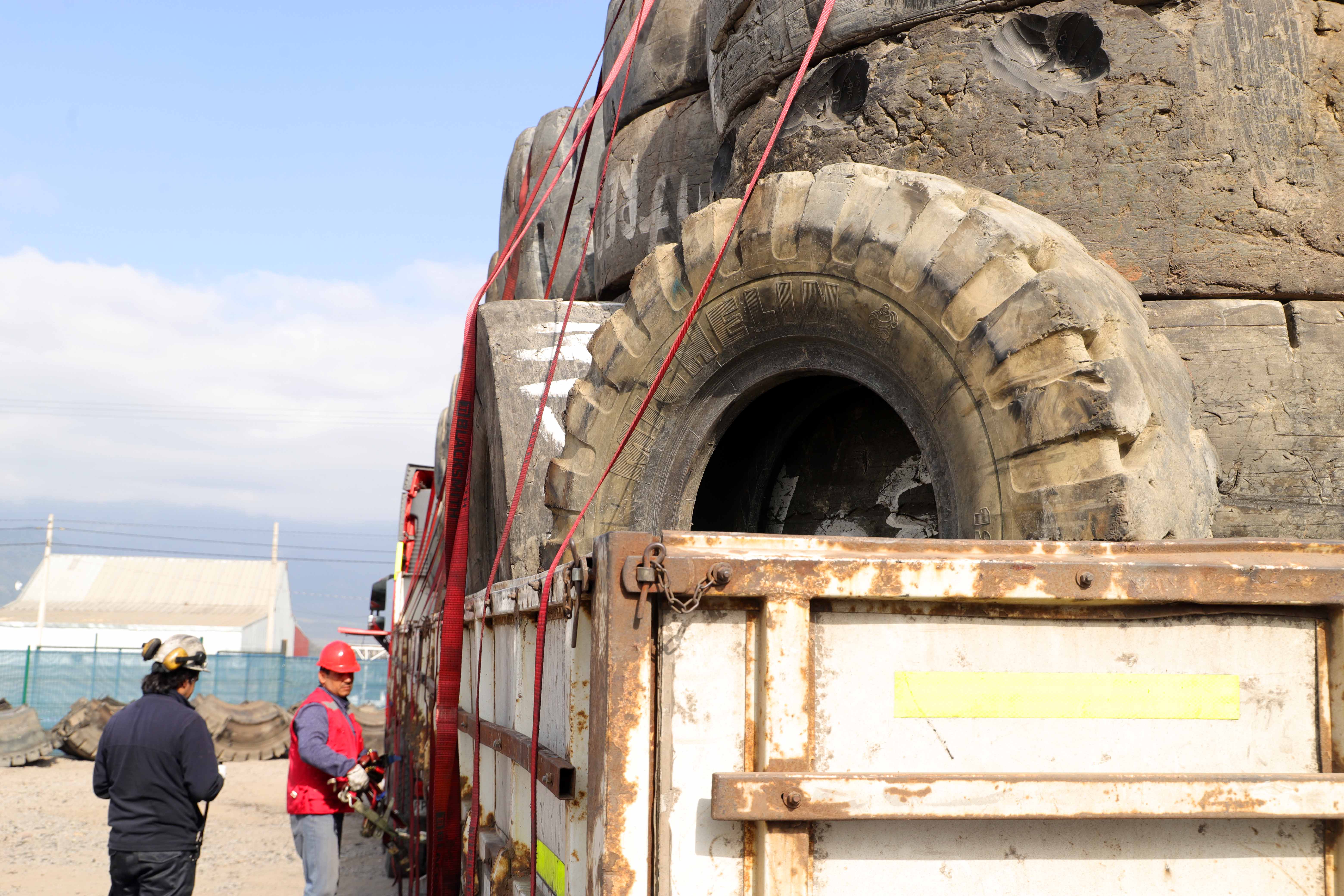
To promote the circular economy and comply with Law No. 20,920 on Recycling and Extended Producer Responsibility (REP), which establishes a framework for waste management, Codelco El Teniente Division began to recover 6,400 tons of End-of-Life Tires (ENDT) that are treated at the Arrigoni Ambiental plant in San Francisco de Mostazal.
The manager of Sustainability and External Affairs of the mining company, Germán Sandoval, stated that “we have to take charge of the future of our copper, as a key material for the future of humanity, and that is why it has to be a copper that is produced with environmental standards of excellence. El Teniente seeks to generate triple value: economic, social and environmental, and with this management we are more efficient in the use of resources and generate a positive environmental impact.”
The process, which is planned for a period of 5 years, began on September 27 and transforms the waste into raw materials for other production processes. During 2023, the cutting, loading and transfer of 806 tons is planned.
The Seremi of the Environment of O'Higgins, Giovanna Amaya, said that "we find it extremely positive that Codelco begins to value this priority waste of the REP Law. We urgently need to change the way we produce and consume, in that sense, companies must leave behind the linear logic for that of a circular economy, in which materials are used in the most efficient way possible and in which production processes do not degrade, but on the contrary, regenerate our ecosystems. The goals of the Law will allow us to prevent this enormous amount of disused tires from ending up in our rivers, streams or illegal landfills, affecting people's environment . "
How does the process work?
End-of-life tires are transported by the company specializing in industrial cargo transportation, TIEx, from the Waste Management Center (CMRIS) of the El Teniente Division, in the Caletones sector, to the suppliers' facilities in San Francisco de Mostazal. They are then treated and valued under a circular economy process, without depositing by-products in landfills.
The company's general manager, Gianfranco Arrigoni, said that "through pyrolysis (thermal degradation of a substance in the absence of oxygen without combustion reactions taking place), our plant produces steel, which will be recycled; black carbon, which can be used as fuel; AANFU Oil, which is an alternative to diesel and can be used in boilers, ovens and motor generators."
Erick San Martín, head of the Circular Economy unit at El Teniente, explained that “this biodiesel has a carbon footprint three times smaller than a fossil fuel, since the tire is composed of a large percentage of natural rubber. The next step is to take advantage of the eco-diesel generated in our production processes, such as the recovery of molybdenum.”
El Teniente's Operations Manager, Claudio Sougarret, highlighted that "it is great news that we can give a new use to the tires used in our operations, especially in the open pit and the underground mine. We are going to work to use the products resulting from this recovery of tires in our processes and thus achieve an effective circular economy."
What does the REP Law establish?
The REP tire targets came into effect on January 20, 2023. From this date, all producers – which, according to the Law, includes all importers of tires, both replacement and new cars – must adhere to a management system to comply with the targets and associated obligations.
The main obligations include compliance with the collection and recovery targets, both national and regional, and the provision of information regarding the status of adherence to a management system in the import declaration before the National Customs System. Both obligations came into force 24 months after publication, that is, on January 20, 2023.
Tags
×