
Operations

Electric Mini-loader Debuts in El Teniente Division, Contributing to Mining Electromobility
The reconditioned machinery with an electric motor is being used in the recovery of steel in Conventional Milling and aims to promote the circular economy and strengthen the sustainability to which Codelco has committed.


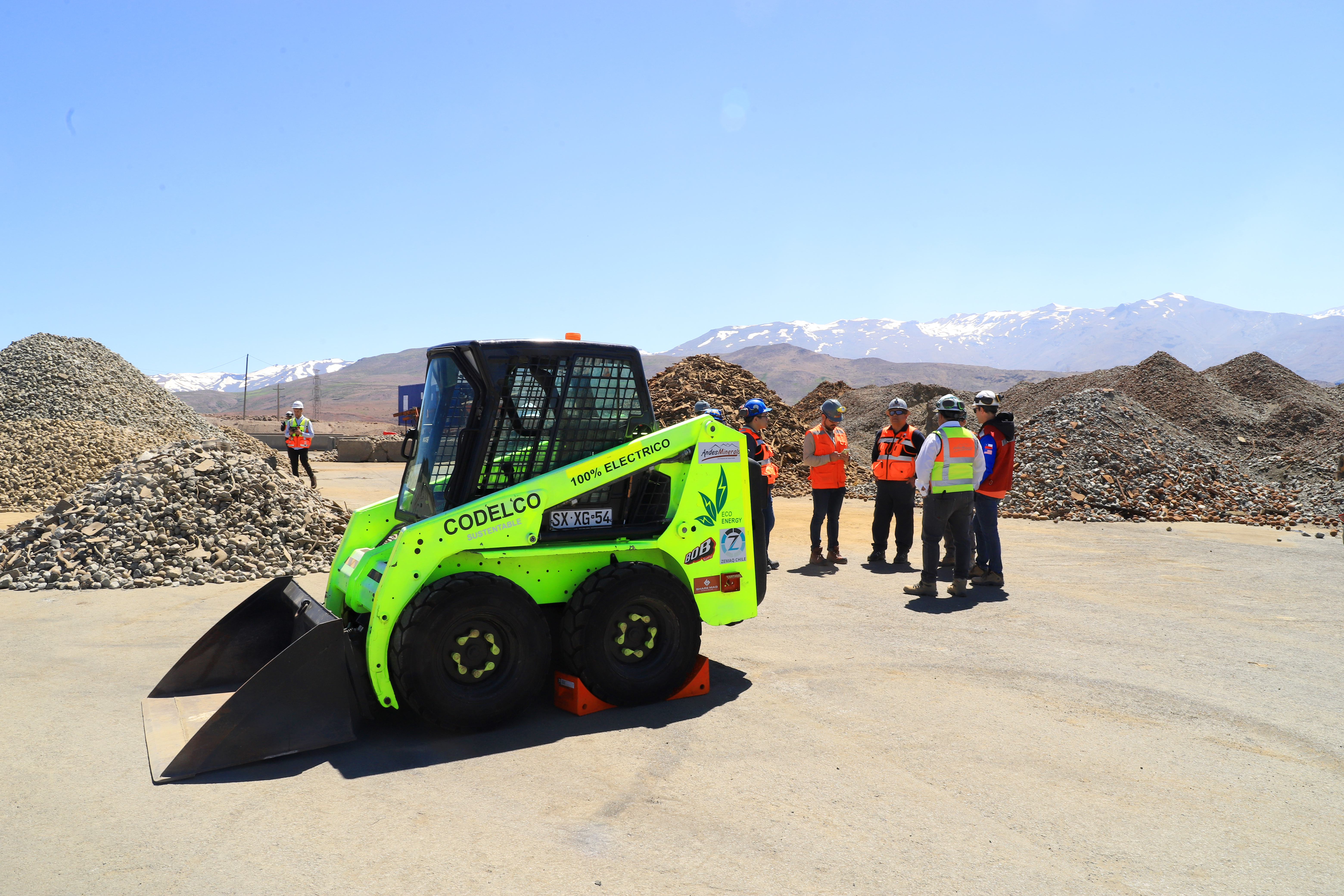
As part of its progress towards innovation and sustainability, Codelco División El Teniente began testing the first mini electric charger in the steel recovery process of Conventional Grinding (MC), in the Plants management, and which strengthens the company's objective with electromobility and the circular economy.
Until now, a crane and an internal combustion mini-loader were used to recover, recycle and reuse residual steel from the MC. To contribute to the sustainability of the process, the company Andes Minerals, in charge of this service, began the transition to electric equipment with the use of a reconditioned mini-loader with more than 10 thousand hours of use.
Roberto Videla, general manager of the company, highlighted that “the recovery of steel from grinding, scrap and minerals already speaks of sustainability in itself, because we give a second life to steel. In addition, the equipment we use must also be non-polluting. By converting unused equipment to electric, we also give a second life to the machinery.”
This initiative adds to the growing electrification of El Teniente, which seeks to achieve 100% electromobility by 2030.
Hugo Olmos, superintendent of Conventional Process Planning, of the Division's Plant Management, highlighted the importance of these projects. "They have a challenging view regarding caring for the environment, with a sustainability perspective. This is a great advance made by a Chilean company, and we, as Codelco, facilitate their ability to generate their industrial test."
This equipment was developed by the company ZeMaq. Its founder, Vicente Bascuñán, said that the development of the electrically reconditioned equipment occurred when he saw that Bobcat machines performed very well, but after 10 or 12 years, they could become obsolete. “We take a piece of machinery that was no longer in use, we check it and change the engine. That is the only thing that is different about it, the rest requires the same maintenance as a conventional one,” Bascuñán explained.
The electric skid steer loader, currently in the testing phase, will replace internal combustion equipment in performing critical tasks. Héctor Piña, head of the Conventional Milling unit and contract administrator for Andes Minerals, stressed the demanding test environment and ongoing performance assessment. “We are in a highly demanding area for the equipment. We are going to test it and see if it meets the milestones that we are defining and that it is part of the contract.”
×