
Operations

Authorities report progress in the implementation of the Mining Royalty in the O'Higgins region
At a new information session in Requínoa, government and parliamentary authorities presented the first results of the distribution of funds from the legislation in the O'Higgins Region.


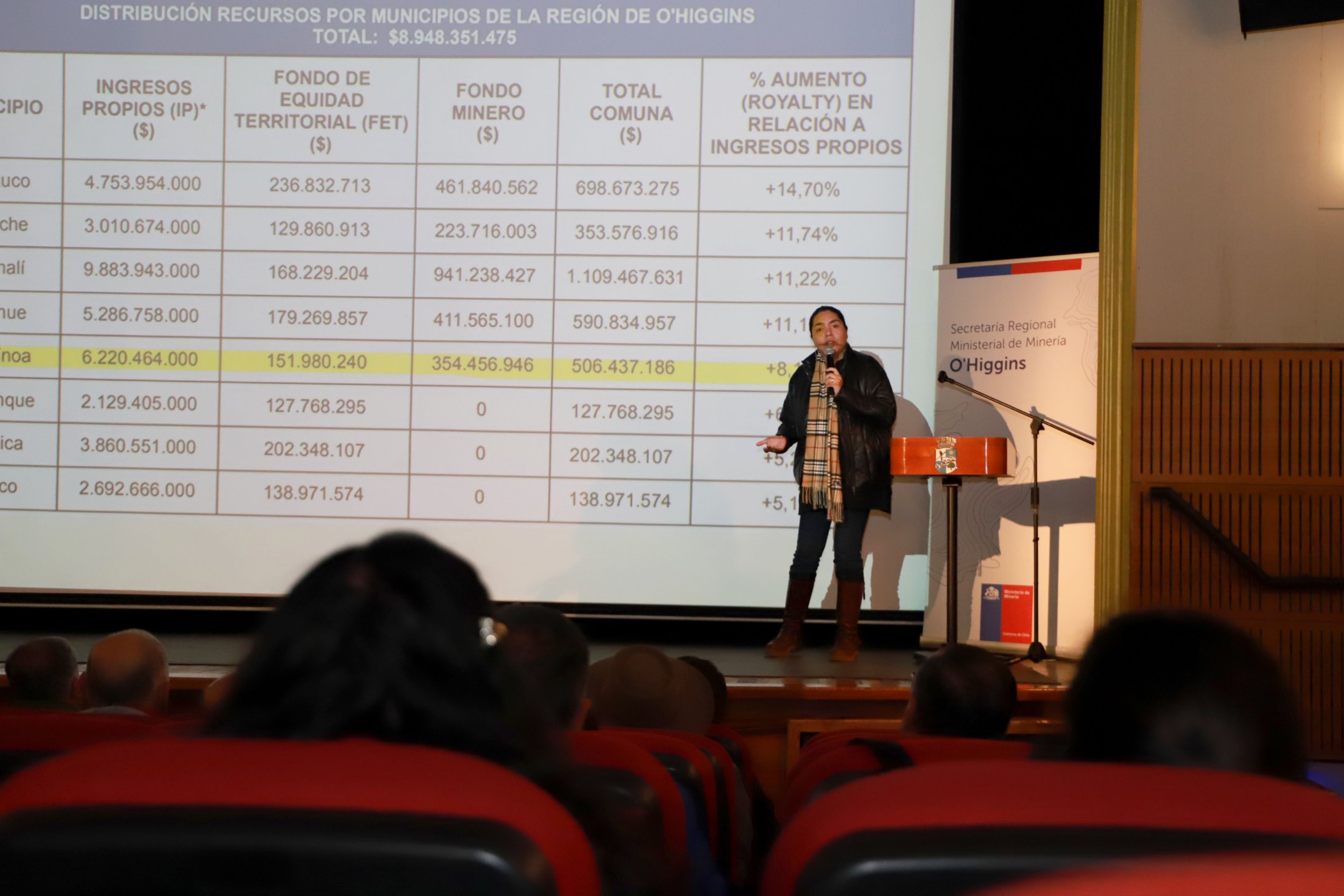
Regional authorities came to the Requínoa theater to announce the progress in the distribution of resources from the Mining Royalty Law in O'Higgins. This initiative, which came into effect in January of this year, distributed 8.948 million pesos in 33 municipalities of O'Higgins , resources for which the municipalities have planned their first destinations.
Bárbara Gavia, regional minister for Mining, stressed that “the reception from the territories has been good. The mayors have already told us how they are going to invest the funds. This is very positive because the communities must be informed on how these freely available resources will be spent.”
Carlos Carrasco, regional minister of government, said that “the balance is extremely positive because the municipalities received resources that they did not have and that next year they will be doubled. Regarding this, there are various mechanisms and orientations that the municipalities have taken.”
Juan Luis Castro, president of the Senate's Mining and Energy Committee, said that "the debut of the Royalty has been a great force in anticipation of its full implementation starting in 2025."
Due to the presence of the El Teniente Division in the O'Higgins region, Rancagua, Coltauco, Doñihue, Machalí, Requínoa and Litueche were recognized as "mining communes" and will receive a total of $3,320,928,632. The rest of the resources are delivered to another 27 municipalities through the Territorial Equity Fund, which will distribute a total of $5,627,422,843 this year.
In addition to the mining royalty, the Division also provides resources to the State to finance public policies that benefit the community through the payment of taxes based on its annual production level and is added to the resources that must be contributed by private mining companies such as Minera Escondida, Antofagasta Minerals, Anglo American, Lumina Copper Mining, Lundin, Glencore, Teck, Freeport–McMoRan, Sierra Gorda SCM, Collahuasi and Capstone Copper, all located in the north of the country.
Cristián Sanhueza, director of Community Development for El Teniente, explained that “the Royalty demonstrates the contribution of mining to the communities in the region. We have learned details of the reception in the different territories and how these resources will be used. We are pleased that these funds will directly contribute to the development of the communities in the region.”
Initiatives for territorial development
In the case of Requínoa, its inhabitants benefited from 151 million 980 thousand 240 pesos through the Territorial Equity Fund and 354 million 456 thousand 946 through the Mining Fund. This implied an 8.14% increase in the municipality's budget.
In this case, the funds will be mainly used to strengthen security with surveillance cameras, lighting solutions and municipal vehicles. In addition, the purchase of water trucks to improve water distribution and the renovation of public squares was announced.
Miladi Moya, president of the Manuel Rodríguez Norte Residents' Association, said that "we never thought we would have any mineral resources, so close and yet so far away. This news is important for us, as residents, as well as for the community."
Margarita Cantillana, president of the El Maitén Residents' Association, said that "it is a great opportunity and help. The Royalty helps all the communes because it is money that was not in the local budgets."
Other municipalities, such as Machalí, have already announced that they will use the Royalty funds to reinforce their emergency response capacity with machinery. For the following quotas received, it will be a citizen decision through community consultations. In communities such as Navidad, Litueche and Pichilemu, they reported that they will prioritize transportation and territorial connectivity.
×